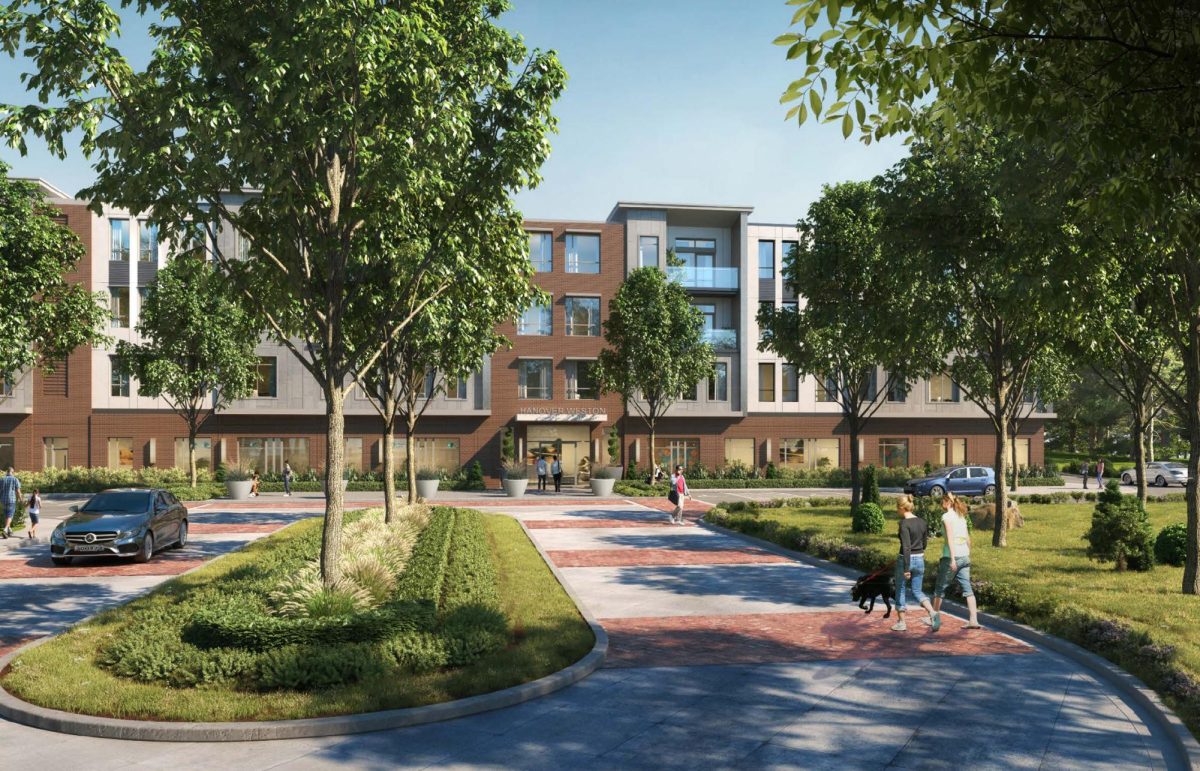
As Weston continues to debate the future of affordable housing in town, proposed affordable housing developments, including the 180-unit apartment complex at 518 South Avenue, are creating a turning point for the town’s views on the issue. The specific project on South Avenue, due to its size and significance, has been nicknamed “The Weston Whopper” as a method of critiquing its potential large-scale effects, even as others in town believe that it represents a change for the better.
While adults in Weston often debate zoning decisions, students experience the issue differently. Many say the controversy reflects a deeper question: Who gets to live in Weston, and why?
“Weston shouldn’t be a town where only families who can afford a two-million-dollar house get to belong,” senior Margaret Liu said. “If we care about fairness, we need housing that lets more kinds of people actually live here.”
The urgency to build affordable housing is being driven by Chapter 40B, a state law passed in 1969 that requires communities to meet a key affordability benchmark, designed to increase affordable housing in communities. One way the state measures that benchmark is through the Subsidized Housing Inventory (SHI), which tracks housing units that qualify as “affordable” under Massachusetts rules.
As of the state’s September 30, 2025 update, Weston has 340 SHI units, or 8.50% of its housing stock, still below the 10% threshold that state law uses as a key benchmark. That figure reflects how Massachusetts counts affordable housing under Chapter 40B housing, including units in developments that have been approved but not yet built.
Under Chapter 40B, a housing development qualifies if about 20–25% of its units are set aside at reduced rents for lower-income people or families. Once it qualifies, all units in the building are counted toward the state’s affordable-housing total, even though most units may be market-rate.
That happened with Modera Weston, a separate 40B development on Boston Post Road, whose 172 units will count fully toward Weston’s total even though only about 45 of its units are income-restricted. Before Modera was approved, Weston had just 3.77% affordable housing.
Many residents describe the town’s housing debate as a clash between local resistance and state pressure, with controversy often hinging on who controls what gets built. That tension frames Chapter 40B.
“Weston has been very reactive to 40B and not proactive,” said Jonathan Buchman, a Weston-area developer involved in the 518 South Avenue proposal.“They figured that they could oppose any projects that came in and drag it out as long as they could, and eventually make it uneconomical.”
Weston’s Zoning Board of Appeals (ZBA) has rejected some large developments like the South Avenue project due to the possible impact on town infrastructure and due to safety concerns, but the state has overridden the rejection of this particular project.
One way a town can avoid the state enacting a 40B override is by meeting specific benchmarks that qualify it for “safe harbor” status. According to the town website’s 40B information (westonma.gov/1010/40B-Introduction), “When a town is below the state’s required 10% [SHI units], the town has an option to proactively plan for developing affordable housing on its own terms by creating a state-approved Housing Production Plan. When this plan is put into action […] the plan becomes certified,” and once that occurs, the town can be eligible for safe harbor status. In contesting the state’s mandated approval of the 518 South Avenue development, the town has claimed that Weston is eligible for safe harbor status, but the state has not yet concurred.
Some students believe that state oversight is necessary to prevent towns from continuing to delay projects.
“Unless the state has the power to step in, I think towns have no incentive to follow the law, and nothing will actually get built,” said junior Ben Rosenfeld.
Weston’s ZBA members and other opponents have argued that a project of this size could worsen overcrowding in schools and public facilities, increase traffic, and strain infrastructure and town resources. Some of these opponents also believe that the very nature of the project is inappropriate for Weston.
“A modern apartment complex is completely contrary to the rural nature of our town,” stated Paul Nolan, a resident of Winter Street, in a letter to the ZBA in 2021 in opposition to the 518 South Avenue project. “Weston has always been a quiet, rural town and we hope it will remain so in the future.”
As the project moves forward and Weston continues to debate its response, the project serves as more than additional buildings, as it has become a symbol of the community’s struggle with change.
“Nobody likes change,” Buchman said. “But without housing options like this, people, especially students who grow up here and might want to live in Weston, won’t be able to come back home.”