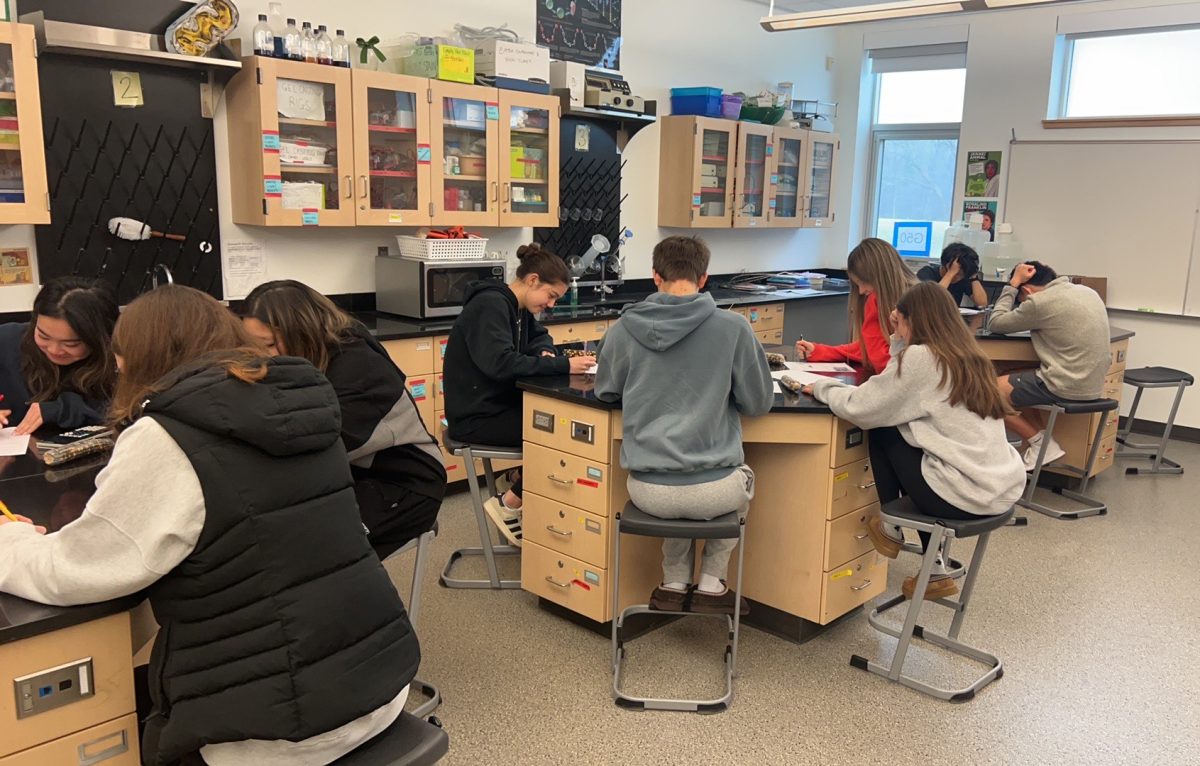
While the school day may end at 3:15 pm most days, WHS students’ academic work often continues into the night as they balance school with sports, clubs, and other commitments. The demands on their time, however, can sometimes seem to increase and decrease, leading to differing opinions about which of the four quarters of the school year is the hardest one to manage..
The quarter system itself plays a major role in shaping how students experience academic pressure over time.
“Each quarter kind of builds on the last,” said junior Josh Burnett. “As the year goes on, expectations increase and grading becomes stricter, but the classes get harder at a pace students are generally expecting.”
However, not all students feel that the workload increases evenly throughout the year, with some quarters standing out as more challenging than others.
“I think the first and fourth quarters are the most challenging,” said senior Sebastian Smith. “In the first quarter, the expectations of the class can sometimes be higher than what students anticipate, and that makes it difficult to adjust to the class.”
For students new to high school, the start of the year can be especially difficult as they adapt to new environments and expectations.
“Quarter one seems to be the most challenging in terms of emotions, just because I work with mostly freshmen,” said physics teacher Ryan Black. “There’s a lot they’re getting used to, like a new building, new social dynamics, new everything.”
As students become more comfortable with their schedules, academic demands often increase as classes move at a faster pace.
“[Quarter two is] when you’re really slammed with work,” said freshman Ally Selvig. “And you can’t look forward to the end of the school year because you’re right at the beginning.”
By the mid-point of the year, expectations become more clearly defined, setting a standard that continues through the second semester.
“Quarter two tends to get challenging just because we start to set the pace more clearly,” said Black. “And that structure carries forward for the rest of the year.”
For some students this reality of growing challenges makes the later quarters more difficult as their coursework and responsibilities continue to build.
“I think the third quarter is the toughest,” said junior Aarav Mehta. “It has a [continuous] schedule and so many tests and assignments, so it can be really stressful to keep up.”
As the year progresses, classes often shift toward more advanced material, making it harder for students to stay on track.
“The third quarter tends to be the most challenging for me,” said senior Curtis Keene. “By the third quarter, classes start covering harder material, especially in subjects like math and science, and the year gets busier overall.”
In higher-level classes, increasing rigor is often intentional as teachers prepare students for future academic expectations. This can be particularly true when students take their first AP class in a specific discipline, having only taken CP or Honors before.
“Honors to AP is a pretty far jump, so I’ll start the year [in AP] a little bit easier, just to lead them in,” said history teacher Angela Lee. “So it’s increasingly harder because we’re trying to get them to [the] AP standard.”
As the school year begins to wrap up, the focus of classes often shifts away from learning new material.
“The year end gets really busy with a lot of things wrapping up,” said Keene. “But [the] fourth quarter isn’t quite as intense. It feels more like a time to review what you’ve already learned rather than tackle a lot of new material, which makes it a bit easier to manage while still staying focused on finishing strong.”
Outside of academics, extracurricular commitments can further limit the time students have to complete their work, and can make those quarters when a student is also part of a sports team or in a show more demanding.
“Having [homework] on top of things after school can be complicated,” said sophomore Warner Hardin. “Our [theater] rehearsals can go until 8:00 and [you won’t] get home until 9:00. Sometimes there’s tests, quizzes, essays, and homework, [so] that’s a lot of work.”
Despite the academic pressures students face throughout the year, developing strong habits early can help them manage their workload more effectively no matter what quarter they are in.
“Students who tend to start off really strong continue to stay pretty strong,” said Lee. “They develop those really good habits at the very start, and then it’s easier to carry it all the way through.”