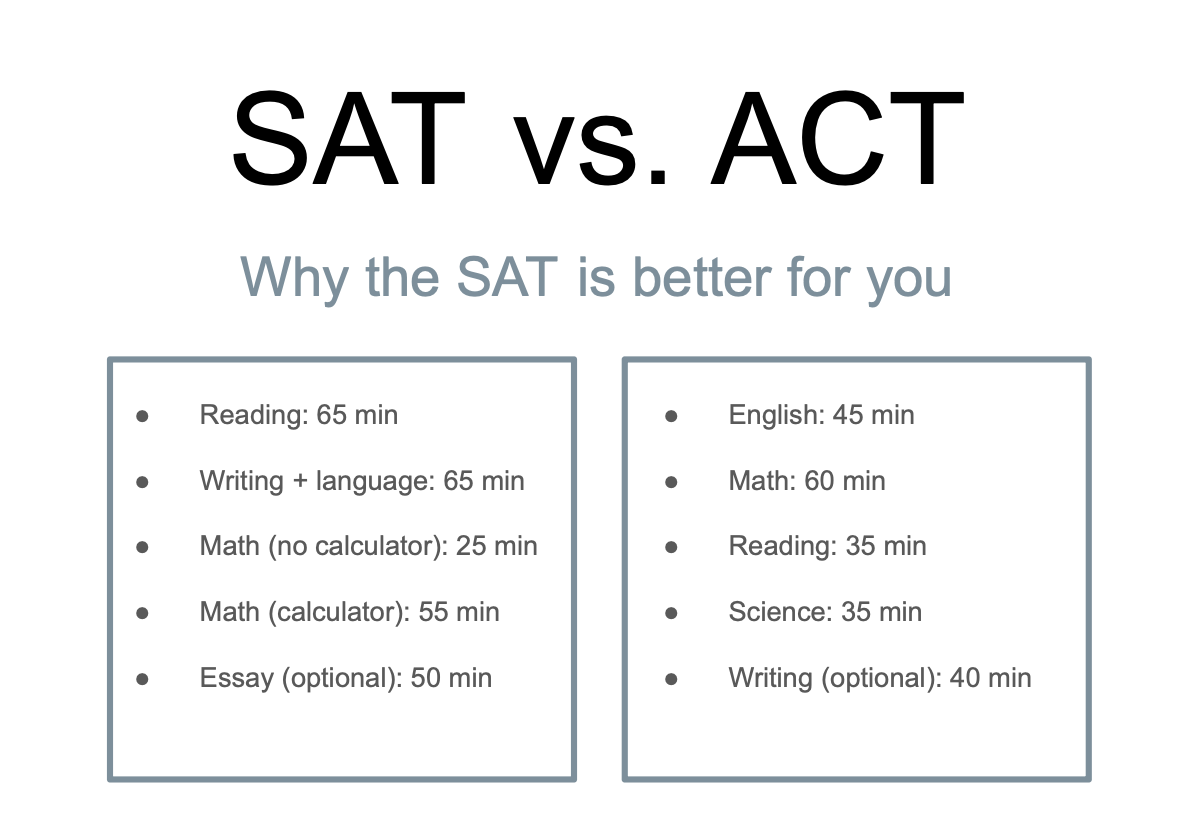
As testing season approaches, students across the school are once again faced with a decision that can shape their college process: whether to take the Scholastic Aptitude Test ( SAT) or the American College Test (ACT). The key difference between the two exams lies in their structure and focus: the SAT emphasizes reasoning and problem-solving, while the ACT is more fast-paced and content-based.
For students like me, who committed to the SAT, the difference comes down to pacing, logic, and the kind of thinking each exam demands. If a standardized test is meant to measure readiness for college-level thinking, I believe the SAT does a better job of doing so than the ACT.
The debate between the SAT and ACT has existed for years, largely because the two tests are structured very differently. I think these structural differences matter because they directly affect how accurately a test reflects what I know, rather than how fast I can move through questions.
“The ACT felt like I was being rushed,” said senior Kirsten Choi. “On the SAT I could actually stop and think.”
Her experience reflects my belief as someone who chose the SAT: it rewards reasoning, while the ACT rewards speed.
I especially agree with this sentiment after experiencing the quick transitions and heavy timing pressures built into the ACT, which personally, just don’t work for me. That difference in pacing has pushed me and many others toward the digital SAT, which has reduced the number of its dreaded long passages.
“The digital SAT is just so much more efficient compared to the digital ACT,” said junior Winnie D’Amaro.
For me, the SAT’s short passages and more analytical questions feel more approachable than the ACT’s dense, rapid fire reading sections. I believe reading comprehension should be about understanding ideas, not racing through text. This leads me to believe that the reading styles of the two tests play a major role in students’ decisions.
“The ACT reading felt like a race where you’re barely absorbing anything,” said senior Thomas Lamb. “On the SAT, I actually understand the text instead of skimming for answers.”
For students who prefer depth over speed, the SAT’s structure offers a sense of control and clarity. For example, doing well on ACT practice tests doesn’t necessarily mean the test measures understanding more effectively; it often reflects comfort with speed-based testing. In my opinion, the ACT rewards quick guessing and surface level comprehension, which can mask gaps in understanding or penalize careful thinkers.
The differences in the math section of each test also divides student opinions. Although the SAT’s math questions can be more layered and word heavy, many test takers actually find that style easier to navigate, as do I.
“The ACT math felt random,” said junior Izzy Wheler. “The SAT math was harder, but it definitely made more sense.”
From my own experience, the SAT feels more connected to the skills teachers emphasize in school. Additionally, it offers demos that can be a huge help when it comes to math. The questions in both subjects – math and English – push you to think logically, read carefully, and analyze patterns, which are the things we actually practice in English and math classes.
“The main reason I took the SAT over the ACT was honestly just because of the English section.” said junior Jeffrey Lan. “On the ACT if you don’t understand one passage, it can bring your score down significantly because there are always several questions related to the same passage.”
For me, this setup makes the ACT feel less forgiving and more punishing. One moment of confusion can impact an entire section, which doesn’t seem like a fair way to measure ability. I believe the SAT’s structure gives students multiple opportunities to demonstrate understanding instead of letting one mistake define their score.
Some people, however, choose the ACT over the SAT because their preparation for testing made it more appealing to them.
“I took the ACT over the SAT because it was the test I did best on during the practice tests,” said junior Sam Doolittle.
As much as I acknowledge that this can be the case, I disagree with this as a rationale for making the choice because a student might perform better on a practice test simply because they are more used to the format, not because the test is inherently easier or more suited to their abilities, which can only really be judged by taking the actual test.
Ultimately, what pushes me firmly toward the SAT is that it feels like a test made for students, not against them. The pacing allows you to breathe. The logic makes sense. The questions build on skills we genuinely use. And unlike the ACT, it doesn’t punish you for not reading at super fast speeds. The SAT asks you to think clearly, not quickly; for many of us, that difference is everything.
“In the end, the SAT was just the better option,” said Lamb. “It was a combination of a test that doesn’t rush you, and one that actually will reflect what you know.”