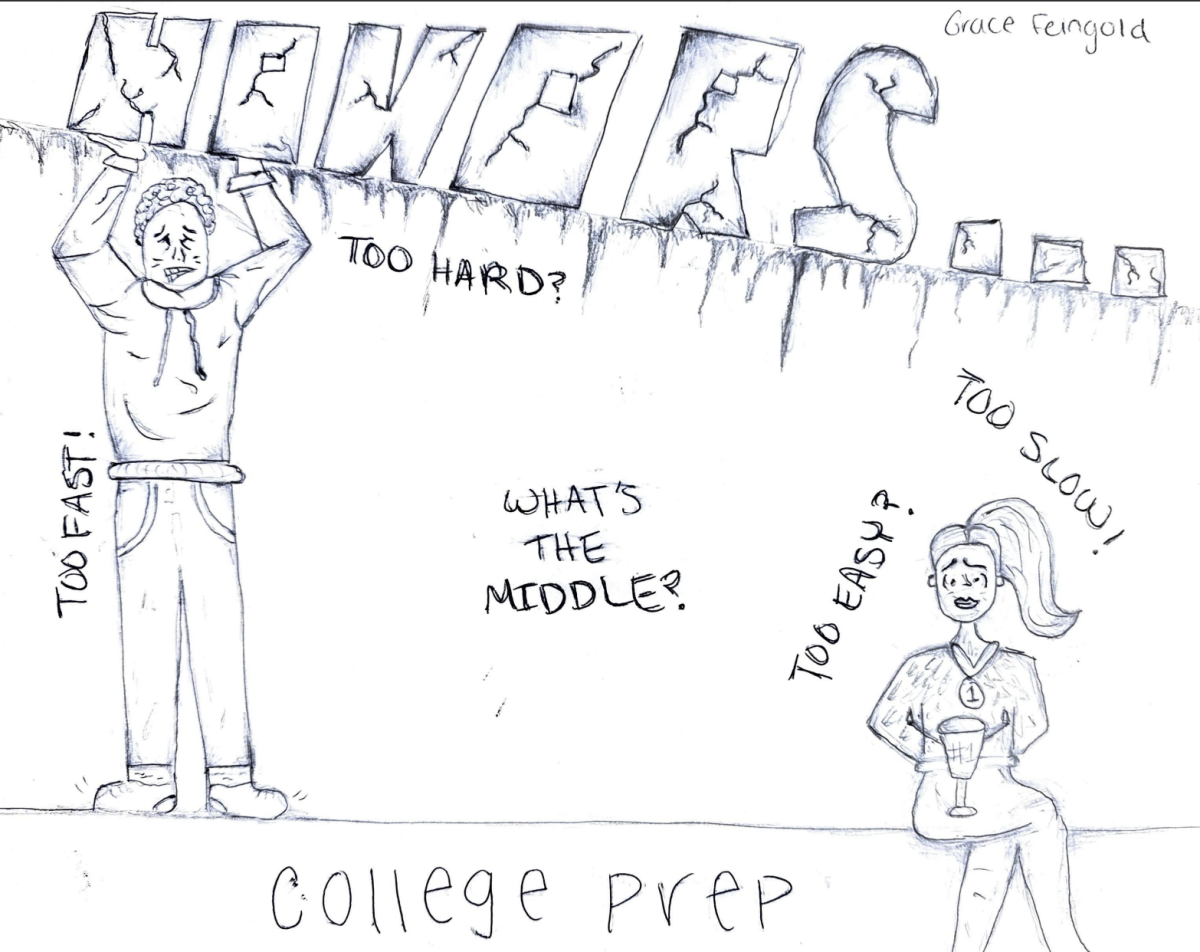
A common and consistent topic among WHS students’ hallway conversations are the differences between College Prep (CP) and Honors courses in the same subject. Slipped into usual small talk is the comparison of the workload, teachers, and pace of classes at different academic levels. Underlying all this discourse is the popular idea of adding a third class level that works as the in-between to these “too easy” or “too hard” classes.
“I feel like for some [courses], yes, there should be [a level] in between,” said junior Taiyu Guo. “Like for math, CP is definitely too easy and Honors math is too hard.”
I don’t believe this suggestion of adding another level to what we already have is a good idea, because this addition could create unintended negative consequences for the students’ wellbeing. Additionally, a shift in student thinking about colleges’ expectations could resolve much of the problem we have in class levels.
There are three total levels to academic classes at WHS: CP, Honors, and Advanced Placement (AP). AP classes are intended to reflect the workload and pace of a college course, while the CP and Honors classes are both aligned with typical high school workloads.
For many students the difference in workload becomes a concern in the beginning of the year when the challenge of Honors starts to feel overwhelming, especially if their first major assessment leads to a grade below the A range, and dropping a level seems like the only solution. Not only are these students making a too-hasty decision; this solution actually creates another problem in relation to the ability to rework one’s schedule.
“For juniors and seniors in particular, things get tighter in terms of the schedule because we’re a small school,” said guidance counselor Chris Shanahan. “You can run into situations where there’s only one section of a specific course running,” and this can make it hard to switch classes.
When a student wants to drop a level but has to change their schedule to do so, they can be shut out of courses that only have one or two sections available, making the move impossible. In reality, adding another level will only make this problem even worse as the more levels of classes there are, the fewer sections of each will be available for schedule changes, creating issues with being able to change courses or levels.
The smaller school size also means that an additional, in-between class would be difficult to execute with the number of teachers and students.
“Weston’s too small of a school for [another level],” said junior Felix Dschung. “There’s a lot of constraints already in class sizes and the number of teachers we have, so [having another level] would probably make learning more difficult.”
It’s important to acknowledge the countless students who have simply struggled with the way class level systems are organized.
“I did CP math all throughout middle school, and when I came up to high school, it was a really huge jump to go into an Honors math class,” said Guo. “It’s hard to make the jump up to a higher level. It’s easy to get stuck.”
I don’t think, however, that changing any part of the academic course system at WHS will have as positive an impact on students as just simply changing the mindset when addressing CP and Honors classes. In WHS, the competitiveness in academics and extracurriculars has created a toxic mindset that does not prioritize student wellbeing. In this environment, which has been a response to the competitive college application process, no one wins.
“I always feel pressure to be in as many Honors classes as I can just because it looks best for colleges,” said junior Hunter Schmidt. “I guess that’s put me into classes where I haven’t succeeded the greatest.”
The mindset of students at WHS is an issue, where pressure makes students believe that they must take a course level that they are not ready for, or be pressured to drop the class level early because they got a score they are not satisfied with. This must change before the discussion of an additional class level would even make sense.
“What I would love to see is students choosing to take courses because they love them, not just because it looks really good on a college application,” said Erin McCarty, English teacher. “So they are challenging themselves in the areas that they want to be challenged in, but also feeling that they have courses that they can access. That would have to be a whole cultural shift.”
One solution that has already been implemented in some classes like the history and language departments is where CP and Honors are mixed within the same class. Changing the way both teachers, students, and parents approach course selection is another way this issue can be addressed.
Students, teachers, and parents must all be more proactive in mitigating the effects of academic pressure and be aware of how this issue impacts students’ decisions when considering what CP or Honors courses to take.