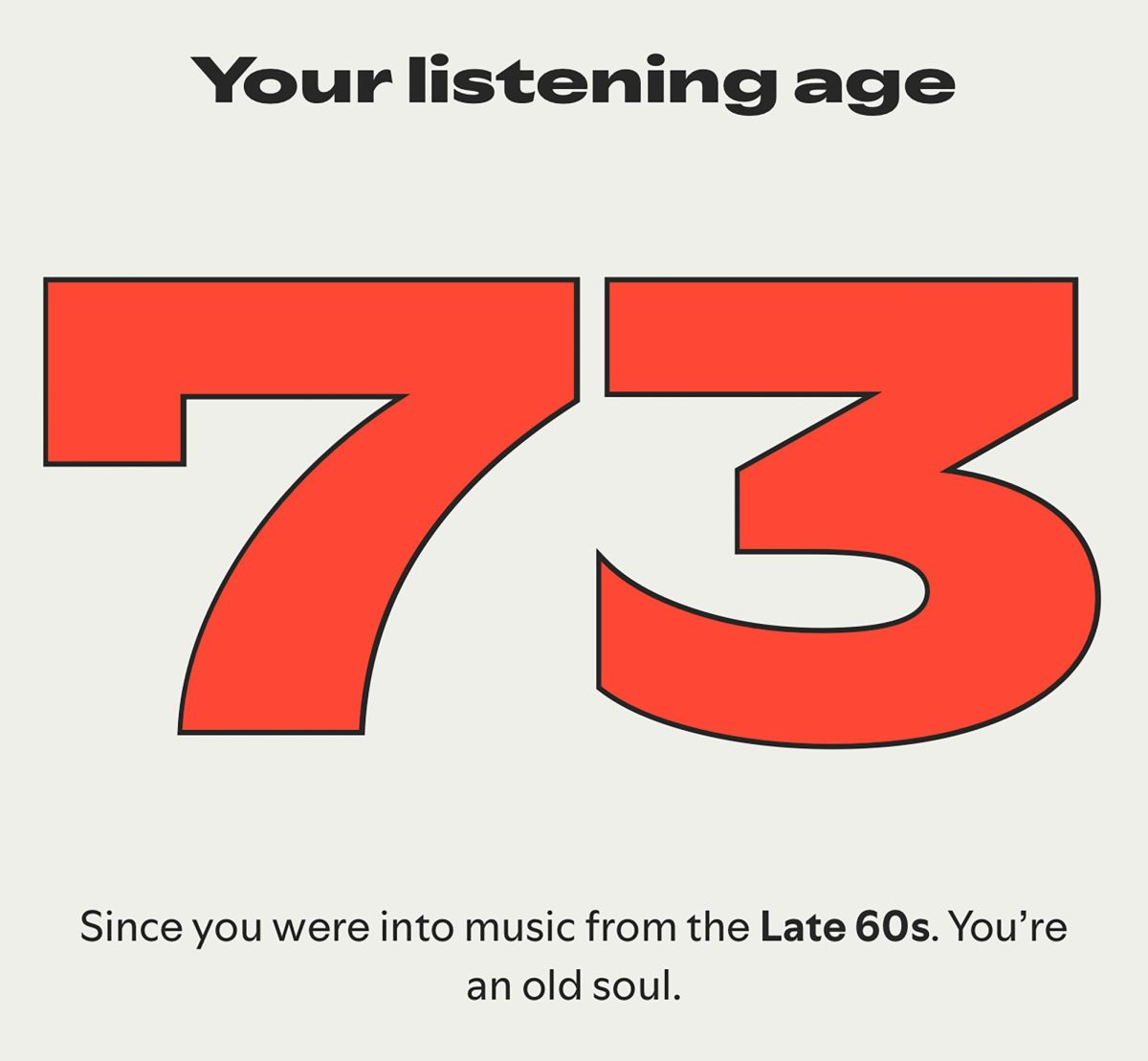
Music streaming platforms like Spotify have become the main source for people to listen to and discover new music. One feature, Spotify Wrapped, reviews users music choices over the course of the year and assigns them a “listening age” based on the songs they play most often, but this often results in some humorous outcomes.
These age labels are often very inaccurate, revealing more about Spotify’s algorithm than listeners themselves. What is meant to be a lighthearted statistic can sometimes leave users confused, amused, or even slightly offended.
Spotify determines a user’s “listening age” by analyzing the release dates of songs listened to from January to November in a given year and identifying the five year period they played most often. Many teachers feel the label can be misleading, especially when their music taste mixes newer hits with classics.
“I listen to house music the most,” said history teacher Caroline Monz. “My Spotify Wrapped said my age was 68, which felt like a direct attack. Even though most of my music is new, older tracks in the background seem to throw off the algorithm”
Students report similar frustrations. Despite listening to trending genres or current artists, they are sometimes assigned ages that are far older or younger than they are.
“I really like music from the 1960s and 70s,” said sophomore Maizie Brown, whose Spotify Wrapped assigned her a much younger “listening age.”
This misnaming of ages spans students and teachers alike, showing how streaming algorithms often misinterpret individual music taste.
“According to my Spotify Wrapped I am 21.” said librarian Erica Lockwell. “but the older music I listen to is usually from the early 2000s.”
While Spotify Wrapped is designed to entertain, it also highlights the variety in listener’s music preferences. Many students and teachers enjoy songs from decades before they were born.
“I listen to a lot of old music, especially from the 50s [and] a lot of old folkish music,” said junior Emerson Fathman. “I like exploring different styles and hearing songs that aren’t really popular with my friends. It’s just kind of the music I enjoy.”
For listeners like Fathman, this range of interest can lead to inaccurate assumptions about age and preferences.
Music streaming platforms like Spotify often label users with a listening age based on their music choices, but Wrapped also highlights other fun statistics, such as top artists, favorite genres, and most streamed songs, both for the individual user and across all users. These features give insight into listening trends across different age groups and highlight how algorithms attempt to categorize diverse tastes.
“The vast majority of our sample members had a ‘listening age’ above their actual age. In many cases, the difference was massive, with several Gen Z and millennials scoring listening ages in the 70s and 80s,” stated “Overanalysing our 2025 Spotify Wrapped: what MIDiA’s stats say about the industry” from MIDiA Research.
Spotify promotes Wrapped as coming to life through data, storytelling, and design working together to reflect each listener’s year in music. Throughout the year, Spotify tracks listening habits, songs, genres and artists in relation to minutes streamed, then transforms that information into colorful visuals and shareable stories.
“Wrapped is about seeing yourself in your sound. Each story is made to be accurate, fair and reflective,” states Spotify on spotify.com.
“I have a mix of older music, with a few newer favorites thrown in,” said librarian Jennifer Barry. “I’m drawn to the 80s and 90s, and some of my parents’ music influences my taste. I’m not into AI generated music, but I enjoy this mix.”
Some students also noted that their music preferences do not always align with the expectations typically associated with their age group. Many described enjoying songs that are considered older or classic by the platform while also exploring genres that are not commonly linked to the listening habits of their peers.
“I listen to way older music, probably between the 1960s to 90s,” said junior David Spada. “I bet some of the older teachers would have similar music tastes. I just like the sound and the stories in the songs. It feels different from what is popular today.”
While many users find that their assigned “listening age” is surprising or even just plain wrong, Spotify Wrapped still attempts to use data to reflect each listener’s unique habits and tastes.
“Behind every colorful card and stat is data that’s as personal as your playlists, shaped to tell the real story of your year of listening,” stated “How Did Spotify Calculate Listening Age? What to Know About the New 2025 Wrapped Feature” from People magazine.