Before the first bell rings at Weston High School, students arrive carrying more than backpacks and unfinished homework. Dunkin’ cups, colorful energy drinks, reusable water bottles, and iced coffees fill the hallways as students search for something to start their day. Although grabbing a morning drink may seem like a simple routine, what students choose can reflect differences in taste, caffeine habits, and even social expectations.
Morning routines can vary widely, particularly as students looking to get a ride in the morning choose between coffee, energy drinks, and other sources of caffeine.
“I feel like everyone has their specific drink that they always get,” said sophomore Alyssa Nie. “Some people get really sweet coffees, some get energy drinks, and some people just get whatever has the most caffeine.”
Those choices at WHS reflect a larger shift in how younger generations approach beverages.
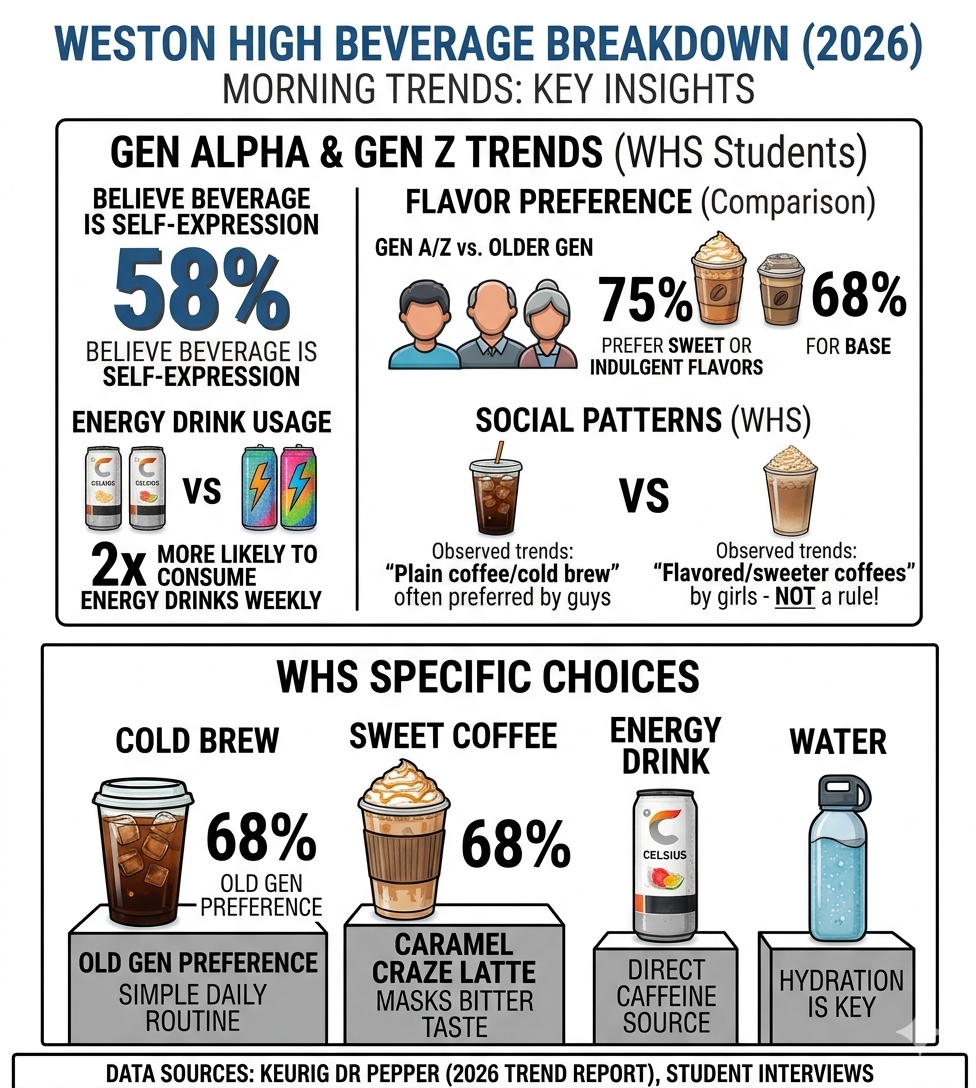
“For Gen Alpha and Gen Z specifically, beverage choice is a form of self-expression,” stated the corporation Keurig-Dr Pepper’s 2026 State of Beverages Trend Report.
According to the same report, 58% of Gen Alpha and Gen Z consumers believe that what they drink reflects who they are. At WHS, these individual preferences can be seen in the specific drinks students make part of their morning routines.
“If I have a drink in the morning, it might be a Dunkin’ cold brew,” said senior Jeffrey Lan. “It’s just cold brew; no foam or anything, no syrups. I think in general there is some sort of expectation for guys to have simpler drinks.”
Others have also noted that gender seems to play a factor in what some students choose to drink early in the day.
“I definitely see more girls getting flavored or sweeter coffees, while a lot of guys I know will just get a plain coffee or cold brew,” said senior Caroline Janis. “Obviously that doesn’t apply to everyone, but I think there’s definitely a pattern.”
National research also points to the popularity of sweeter options among younger consumers.
“75% of Gen A/Z prefer sweet or indulgent flavors [compared with 68% of older consumers],” stated the KDP report.
However, these perceived patterns do not necessarily determine what someone chooses to drink.
“I don’t really think about whether a drink is for guys or girls when I’m choosing one,” said junior Kian Kourtidis. “I’m probably just going to get whatever I like or whatever is going to wake me up.”
Beyond social perceptions, students’ drink choices can also be shaped by taste and how much energy they are looking for in the morning.
“I pretty much get a sweet coffee from Dunkin’ every morning to mask the bitter taste of coffee,” said senior Sophie Belotte. “My usual is the Caramel Craze Signature Latte, because refreshers don’t give me enough energy.”
While energy drinks are a common source of caffeine, some students specifically avoid them as part of their morning routines.
“I would never drink a Celsius in the morning,” said Lan. “But I would maybe [have one] in the afternoon to try to keep me from falling asleep before I need to actually fall asleep.”
Energy drinks have become particularly prevalent among younger consumers.
“[Gen Z and Gen Alpha are] 2x more likely to consume energy drinks weekly [than older generations]” stated the KDP report.
Energy drinks can also offer a more direct source of caffeine than a customized coffee order, adding another option for students looking for an energy boost.
“If I need energy, I’d rather just have something like a Celsius because I know what I’m getting it for,” said Janis. “It’s more about the caffeine for me than having a whole coffee order.”
Despite the variety of caffeinated drinks available, not every morning choice needs to provide an energy boost. Hydration adds another consideration to the different beverage choices students make to start their day.
“I think everyone should drink water in the morning,” said Lan. “Water is underrated. People need to drink more water.”
Whether students walk into WHS carrying cold brew, Celsius, a flavored coffee or simply water, their choices reflect a combination of taste, routine, energy, and personal preference and also generally reflect the broader national trends for young people’s beverage purchases. Rather than pointing to one dominant morning drink, the variety throughout the hallways reflect the different purposes beverages can serve.
“I think you notice trends, but I wouldn’t say there are actual rules about what people drink,” said Janis. “At the end of the day, people are just going to order what they like.”