Weston High School students returned to school this fall to several changes, including stricter cell phone rules, changes to junior privileges, and new study hall expectations.
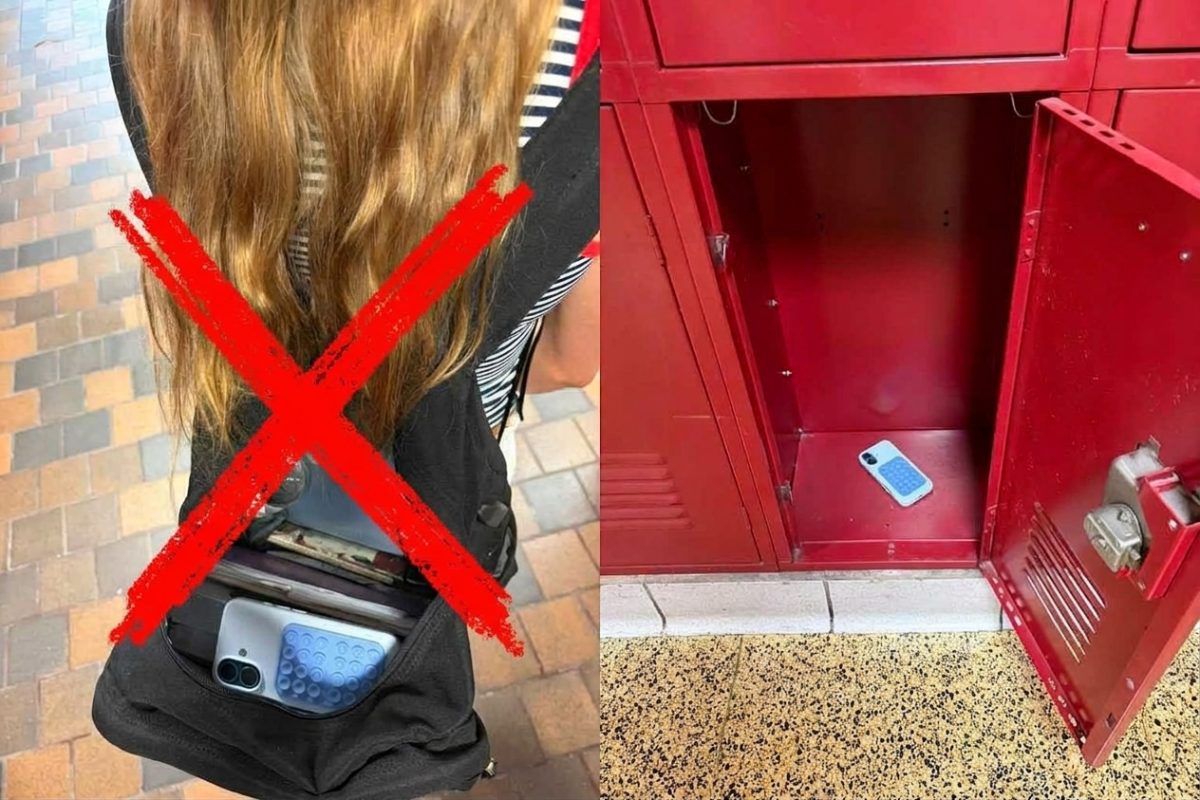
Under the new bell-to-bell personal technology use policy, students are expected to leave phones and other personal electronic devices, such as bluetooth headphones, in their lockers from the start of first period until dismissal. The policy replaces the previous “phone hotel” system, which required students to place their phones in classroom phone holders during class but allowed access during passing periods, lunch and scheduled free blocks.
Students and teachers have reported mixed experiences with the policy. In an anonymous poll of 42 students across multiple grades, all 42 reported keeping their phones outside their lockers, most commonly in their backpacks or pockets.
“I don’t think the cell phone policy has limited cell phone use because I’ve seen kids using their phones in class more,” said senior Jenna Cutter. “People use the iPhone mirroring feature.”
When phone mirroring – connecting to their phones via laptops – phones must be within 30 feet of laptops for the mirroring to work, so the extensive use of it further indicates that students are not keeping their phones in their lockers, creating questions on how best to enforce the new rule for teachers and administrators.
“We are saying [phones] have to be in your lockers. That is the expectation,” principal Susan Bairstow said. “The mirroring is a little bit harder because you own your device. So this is a question the administration has with the personal electronic device policy.”
Despite students’ reports of continued access to their phones, some faculty members have noticed fewer phones in use.
“I have not seen any phones out,” said special education psychologist Jess Arena. “I know kids aren’t putting them in their lockers, but nobody keeps them out. I saw phones out all the time, in the hallways and in class, last year.”
Other teachers note that the policy has changed both how often phones are visible and the broader environment in the school.
“I think the blanket enforcement being changed has changed the overall culture of phones being present in the building,” said speech and language pathologist Brandon Jurewicz. “Although very strict, I think it is something that unifies teachers and students across the board.”
For students lack of access to phones has created practical problems.
“In between classrooms it’s hard to know your schedules without checking your phone,” said senior Milly Wang.
Communication with parents has also been a concern for some students who don’t have ready access to their phone.
“If you want to contact your parents, you have to go to the main office and air your business in front of everyone,” said sophomore Ally Selvig. “Last year it was so easy to just shoot a text to your parents.”
In a separate poll of 24 students, 20 preferred the previous phone-hotel system, three preferred the new policy, and one was indifferent.
“I don’t think [the cell phone policy] really makes any big positive impacts,” said junior Neeve Callanan. “Kids are going to try to get around it anyway. The phone hotels worked fine as long as teachers took attendance with the phone hotels. ”
Students also question whether this new policy has created new enforcement problems.
“If anything the new policies make it easier to cheat because there’s no way of knowing if someone just has their phone with them,” said senior Hailey Andrasco.
Administrators have heard from many students about the policy and will continue to welcome their input.
“We would like to get feedback from students. How should we change this policy?” Bairstow said.
Student feedback has already led to one change in the policy in relation to use of iPads in school, which were originally banned.
“At the beginning of the year, a lot of students came and said, we take notes on iPads,” said Bairstow. “We contacted the school committee and they said if kids are using them as an ‘academic device,’ we can allow that.”
Another change that has affected juniors relates to whether they are allowed free blocks during first or last blocks. In the past, juniors were not assigned to study halls during those blocks but had “frees” and didn’t have to be in school.
“When we were freshman we looked forward to junior privileges,” said junior Max Wong. “But now being a junior is the same as being a sophomore.”
Students also see a connection between first- and last-block frees and sleep.
“Junior year is super stressful and it’s only September,” said junior Ella Cahill. “All these studies show that sleep improves mental health and productivity so it would be super helpful if I had a first block free and could sleep in.”
Some see these changes as creating a lack of freedom that is impacting the student body.
“Kids would enjoy going to school more if they had more freedom,” said Callanan.
Bairstow explained that the decision to eliminate first and last block frees for juniors was tied to the State’s requirement for 990-hours per year of instructional time.
“It did not help with the State requirements for time on learning,” Bairstow said. “We have to have kids in school.”
Study halls and coverage for absent teachers have also changed for the 2026-27 school year, in part in relation to the same 990-hours rule. Students now no longer have frees or cafeteria study halls when a teacher is absent and instead report to their regular classroom for the block with a substitute and usually with assigned work to complete, including seniors who used to have free time when teachers were absent. While some students dislike this change, many understand why these changes were necessary, though they question the need for so much supervision.
“I do understand that we need more class time, but if we don’t do the work, we get the zero so there’s really no point in having a teacher there,” said senior Arya Bhargava.
Other seniors feel that this change ignores their age and ability to make good choices.
“I don’t understand why it is necessary to lock literal adults inside the building, especially when we already have open campus,” said senior Matthew Fitzgibbon.
The move from the cafeteria study hall to classrooms has also changed the environment of study halls for everyone.
“I really miss cafeteria study halls. It was always great to be able to see all your friends who had a study hall at the same time, and it was definitely better for collaborative work,” said junior Meghan Byrnes.
From the administration and many teacher’s points of view, the previous cafeteria study halls and frees for some students made it difficult for absent teachers to ensure their classes completed assignments.
“That was not working because kids were not doing the work,” Bairstow said. “Teachers were not feeling like they could leave meaningful work for kids to continue what they were learning.”
While these changes were largely made in response to State law or school committee policy changes, the administration is open to continuing to gather feedback and reassessing elements of the chnages.
“We’re always open to hearing from students and when we can, we’ll try to adjust whatever is truly not working,” said assistant principal Chris Martin.