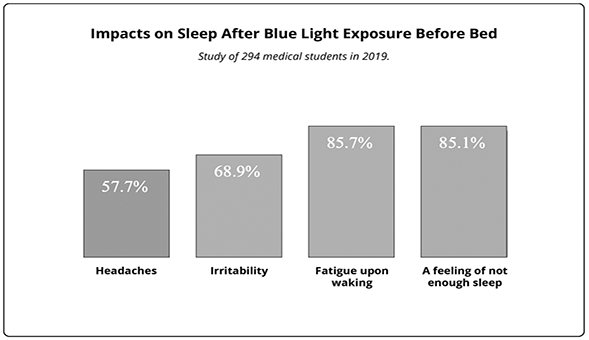
Many students keep their phones within reach after lights are turned off, extending screen time into late hours and shaping daily sleep schedules. The constant access to social media, messaging apps, and streaming services makes it difficult for students to disengage and have a restful sleep.
“I feel like a lot of students struggle with screen time. It’s hard to stop scrolling,” said senior Searcy Kilgallen.
Many students go through the “screen time spiral,” especially at night, and the effects become apparent during the school day.
“Students definitely struggle with phone usage before bed; it just makes people more tired overall,” said guidance counselor Gretchen Gugliotta. “I would definitely tell students to avoid being on their phones at least an hour before going to bed as it’s overall better for you.”
Professionals who focus on student health issues note the problems created by nighttime phone use extend beyond feeling tired the next day.
“Phones should not be kept in the bedroom during sleep,” said wellness and health education teacher Danielle Cooper. “They emit blue light, which tells the brain to stay awake. Teens who sleep with phones nearby often wake up more frequently and get lower quality rest.”
Research suggests that at night, blue light disrupts the circadian rhythm. This rhythm, also considered the body’s biological clock, can be thrown completely out of whack, causing many people to experience sleep problems, as noted on Harvard Health Online+ (health.harvard.edu).
For some students, parents enforce rules around nighttime phone use in order to prevent the damage caused by too much time online.
“My parents take my phone at night. It’s kind of annoying sometimes, but in the end it’s probably the best for me,” said junior Kate Lamb.
Student-athletes like Lamb may benefit the most from this kind of restriction as phone usage at night can affect them even more directly due to their strenuous schedules in and out of school.
“It for sure takes a toll on athletes. Before my parents took my phone, I would spend so much time scrolling,” said Lamb. “I just think it makes you more tired overall, which makes it hard to perform to the best of your abilities within your sport.”
Cooper noted that teens need about 9 hours and 20 minutes of sleep per night, but most aren’t getting that.
“Phones make it even harder to meet that goal,” said Cooper. “Students who reduce screen time before bed tend to have better focus and overall mental health.”
On the other hand, some students don’t see having their phone nearby as a distraction and say they are not constantly using it.
“I sleep with my phone in my room at night, [and] I don’t think it’s that big of a deal especially because I’m not on it 24/7,” said Kilgallen. “It’s definitely good to not be on your phone. It definitely is a distraction.”
Students like Kilgallen believe they can balance the convenience of having their phone close with an awareness of the potential disruption to sleep and focus. Other students implement stricter routines to completely limit nighttime distractions, which can be beneficial for many people.
“I don’t get on my phone until I’m about to leave the house in the morning. I think it makes me more productive,” said junior Leah MacDonald.
By waiting until the start of the day to check devices, MacDonald limits interruptions both during sleep and homework time. This approach also allows students to focus more on morning routines and responsibilities without the pull of notifications.
Others try to moderate usage without completely removing the device.
“I try to set my phone down at the same time every night,” junior Luke Betty said. “I keep my phone in my room at night.”
For some students, avoiding phones at night is part of a conscious effort to prioritize rest.
“I’m not on my phone at night,” said sophomore Colin Sumsion. “It can be annoying sometimes, but it’s probably better for me.”
According to the Journal of Adolescent Health, health professionals suggest that students can implement small, intentional changes to reduce the impact of nighttime phone use and to enforce boundaries without relying solely on willpower.
“Even small habits like putting your phone across the room or turning off notifications can make a big difference in how rested you feel,” Gugliotta said. “It’s about creating an environment that encourages rest instead of constant engagement.”