Between juggling homework, tests, sports, extracurriculars, and more, it can be hard for busy high school students to stay organized and prepared during the school year. I believe that through time management as well as organizational habits and tools, students can keep their lives on track and make their high school experience much easier and smoother.
In order for students to improve their pre-existing habits or implement new strategies, I think that it is crucial to understand what exactly time management means.
“Time management is about making deliberate choices about how to allocate your time based on the importance and urgency of tasks,” stated the National Society of High School Scholars, (nshss.org). “It involves setting clear goals, breaking them down into smaller, manageable steps, and then allocating specific time blocks for each task or activity.”
I sometimes find it very difficult to stay focused on homework, especially when I’ve already been working on a particular assignment for a long period of time. Because of this, I think it can be beneficial to organize and carve out time with a strategy called the Pomodoro Technique, which inolves focused and efficient work for 25 minutes, then taking five minutes as a break to rest your brain.
“I might cycle through the Pomodoro timer two or three cycles, and usually by the end, I’ve accomplished a lot since I stay focused without distractions,” said history teacher Angela Lee.
The Pomodoro Technique and other planning strategies can lead to unexpected benefits, therefore reinforcing the value and importance of time management.
That being said, I also think it’s essential for students to identify a motive or multiple reasons to begin implementing and upgrading current habits. This has proven to be beneficial for students.
“When I manage my time, there’s certain windows when you have finished your homework, and then you just have so much free time,” said junior Maxwell Wong.
Another advantage from this kind of organization is that it helps me cope with the anxiety I feel when homework and tests start to pile up and when it feels like there’s a lot to be done in a short period of time. I’m not alone in recognizing this added benefit.
“[Time management] just makes everything so much less stressful,” said freshman Elena Tetreault. “It organizes everything together and makes it so that you’re not behind on anything.”
Then, obviously, there’s the issue of how to make time for one of the most important elements of surviving high school: sleep. When I dedicate time in my day to get ready and unwind before bed, I find myself sleeping more hours and having a better quality of sleep overall.
“It is helpful to schedule when to sleep and to create a bedtime routine,” said health teacher Leah Hall. “For example, at 9:30, I’m going to close my laptop, turn off my phone, then I’m going to read a book or do something that doesn’t involve a screen to relax before bed.”
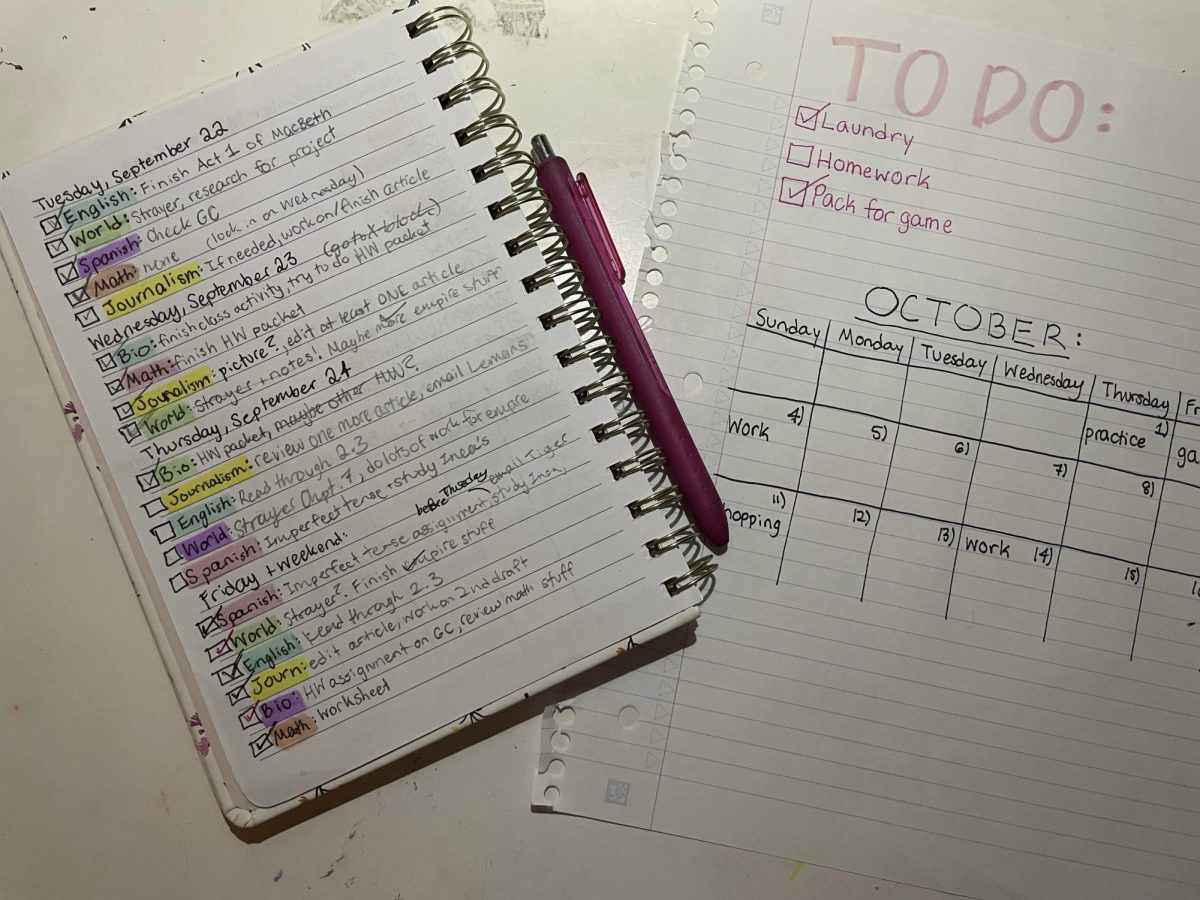
When I’m at school, one of my personal favorite strategies to help me cope with the workload is writing down my homework in an agenda because it’s a very simple and low-effort way to help me not forget the things I have to get done.
“I have my agenda in my backpack at all times,” said sophomore Ian Siwik. “When I write down my homework, I memorize it more, similarly to when I make my flashcards to study for my world language.”
For longer-term obligations or assignments, an option is to put the deadlines or due date on a monthly calendar at home so you keep them in mind day-to-day.
“A physical calendar posted where you’ll see it every day can be a great, tangible reminder of what you’ve accomplished and what’s coming up next,” stated Stanford University, (teachingcommons.stanford.edu). “Writing things down on a digital or paper calendar helps free up your attention for learning by eliminating the worry of having to remember them.”
Obviously, these time management strategies are what works for me and some students, but I believe that it’s necessary for each person to explore and try out varying approaches, as there are countless strategies out there.
“Everybody’s different, so one technique might work for one person, and another might work better for other people,” said Hall. “So try something new, and if it doesn’t work you can change it a little bit or try a different method.”
Regardless of what time management, organizational strategies or habits a student employs, I firmly believe that implementing any of them will allow for a greater sense of peace, control, reduced anxiety, and overall make one’s high school life easier, as it does in my own life.
“[Time management] improves my life a lot,” said senior Reva Vaddi. “I think that my life would be pretty chaotic and disorganized without my great time management skills.”