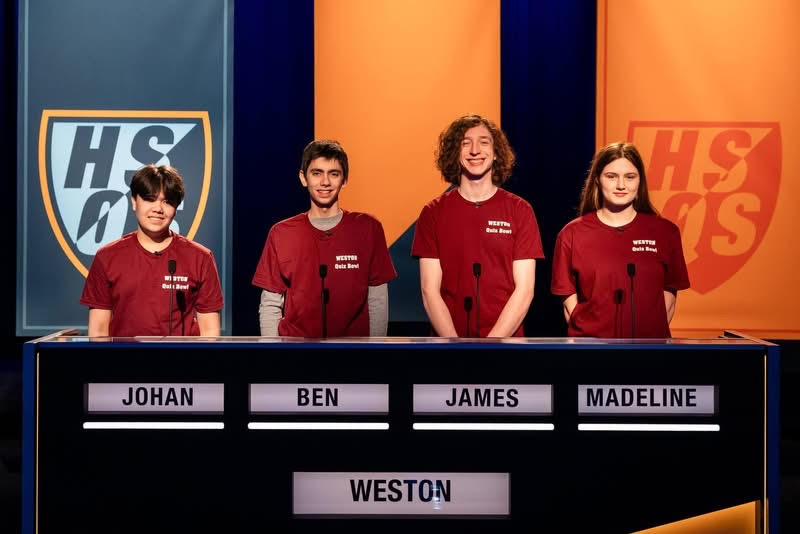
The WHS Quiz Bowl team competes in a range of venues by having a team of four players face off against another school’s team of four using a buzzer system to answer questions on a range of topics, designed to test a mix of types of knowledge, from school curriculum to popular culture.
“The questions we receive are generally pretty short questions that sometimes come from the things I learn in school, and sometimes the questions are more like things people would consider fun facts,” said junior Ben Rosenfeld.
The team participates in many different tournaments, including those broadcast by WGBH, the local public media station, called High School Quiz Show, as well as independent competitions against other high schools’ teams. Televised competitions use a structured format with Toss-up, Head-to-Head, and Category rounds, where players can buzz in freely without penalty. This changes in the final Lightning round, which introduces penalties for wrong answers to increase the stakes. Conversely, regular competitions are much simpler, featuring a continuous stream of questions without specialized rounds.
During the independent competitions, one moderator reads clues and players must buzz in to provide correct answers to earn points for the team. While the broadcast appearances generate local recognition, the rigor of that setting differs significantly from what is found at typical weekend invitationals matches.
“The questions are a lot easier on TV because it makes for better TV,” said senior James Lundberg. “The High School Quiz Show is just something we happen to do… but it’s actually relatively unrelated to Quiz Bowl itself.”
Beyond the televised matches, the Quiz Bowl team competes in a variety of tournaments across Massachusetts that serve as qualifiers for national events.
“We were close to qualifying for nationals this year, but didn’t quite make it,” said freshman Johan Coisman.
To determine who appears on the televised roster, the team’s coach, Alison Langsdorf observes many different factors.
“Mrs. Langsdorf had us take a written test and also observed how fast we were using the buzzers and what our level of accuracy was, as they deduct points for missing questions, ” Coisman said. “Then, Mrs. Langsdorf assembled a team to ensure that [they] could cover all major topics. My areas of expertise were ancient history, mythology, and fast geography questions.”
To prepare for the high-stakes events, the team holds weekly practice sessions to refine their skills. These sessions focus on team chemistry and building comfort with the buzzer system rather than rote memorization.
“It helps us get closer as a team,” Lundberg said. “But [it] also gets people more comfortable buzzing in [even] when they’re a little unsure.”
The training is designed to prepare students for handling the pressure of all different types of tournaments. Many come to learn that whether the tournament is on the WGBH quiz show or at a regular competition, quick thinking is often more important than knowing obscure facts.
“You’re not training for facts, you’re training about getting more comfortable with answering and being wrong,” Lundberg said.
Unlike other schools that have an expert for each category like history or science, the WHS team relies on a more flexible approach where any player can attempt any topic.
“Whoever gets the answer, gets it,” Rosenfeld said. “In a bigger school, [they might have specialists], but we don’t have people that do something like that.”
Quiz Bowl participants often find success by focusing on specific academic subjects or by developing a broad base of knowledge to support their teammates.
“Most students who come to Quiz Bowl already know a lot of information in at least one area, but some are more generalists who know a little of everything,” said advisor Alison Langsdorf. “Either is fine. It’s a team game, so no one needs to know all of the information on their own.”
The recent success of the team has also led to more notoriety around WHS.
“I know of them,I know Ms. Langsdorf coaches them, and [that] she’s very devoted,” said English teacher Tera Kemp. “I know that they’ve been really successful in recent years. I think [the show] is a great idea, and I’m curious about how they train.”
The squad’s collective focus and ability to perform under pressure resulted in significant achievements throughout the winter months.